
The senior living industry reached its strongest overall reputation performance of 2026 in November.
Across 7,059 monitored communities, the average Senior Living Reputation Score increased to 85.26. The percentage of communities in the strongest performance tier also reached a new high, while the percentage considered at risk continued to decline.
At the brand level, Kensington Senior Living retained the top position. Dial Senior Living remained close behind, while Arden Courts made November’s most notable move into the top five. Arden Courts, Highgate Senior Living and Touchmark join this month’s top 10, replacing Marquis HCS Senior Housing, Western States Lodging and Management and Vi Living.
Our 100-point reputation score evaluates four aspects of a community’s Google review performance: overall rating, positive-review recency, positive reviews received during the past 12 months and sentiment across the three most recent reviews.
To keep the brand leaderboard focused on operators with a meaningful portfolio, brands must have at least five monitored communities to qualify.
Kensington Senior Living remains at the top of the leaderboard with an average reputation score of 96.12 across eight communities.
All eight communities score 90 or higher. Kensington also improved its average by 0.25 points from October.
Dial Senior Living remains in second place with an average score of 96.02 across 26 communities.
Twenty-five communities are in the strongest performance tier, with the remaining community in the needs-improvement tier. None score below 75.
The Arbor Company ranks third among eligible operators, averaging 95.41 across 48 communities.
Forty-seven communities now score 90 or higher—one more than in October—and the remaining community is in the needs-improvement tier. The Arbor Company continues to combine an elite average with exceptional consistency across a larger portfolio.
Thrive Senior Living moves into fourth place with an average score of 94.85 across eight communities.
Seven communities score 90 or higher, and none are in the at-risk category. Thrive’s average increased by 0.63 points during the month.
Arden Courts enters the published top five after posting November’s most significant improvement among the leading operators.
Its average score rose from 92.82 to 94.68 across 55 communities. The number of communities scoring 90 or higher increased from 46 to 51, while the number below 75 fell from two to zero.
That means nearly 93% of the Arden Courts portfolio is now in the strongest performance tier, with every remaining community in the needs-improvement tier.
MBK Senior Living ranks sixth with an average score of 94.46 across 38 communities.
Thirty-four communities score 90 or higher, with the remaining four in the needs-improvement tier. MBK has no communities below 75.
Highgate Senior Living rises to seventh place with an average score of 94.37 across ten communities.
Nine communities are in the strongest tier, with one in the needs-improvement tier. Its portfolio average increased by 1.05 points from October.
Silverado Senior Living ranks eighth with an average score of 94.36 across 26 communities.
Twenty-three communities score 90 or higher, and the remaining three are in the needs-improvement tier. None score below 75.
Touchmark returns to the top 10 with an average score of 94.19 across 15 communities.
Every Touchmark community now scores 90 or higher. Its average increased by almost a full point during the month.
Watercrest Senior Living completes the November top 10 with an average score of 94.13 across seven communities.
Six communities are in the strongest tier, with one in the needs-improvement tier and none below 75.
These ten operators represent 241 senior living communities.
Of those communities:
That last figure may be the clearest indicator of what separates the industry’s reputation leaders.
The strongest operators are not relying on a few exceptional communities to raise their averages. They are producing consistently strong results while preventing individual locations from falling into the at-risk category.
Arden Courts illustrates this particularly well. Its November improvement did not come from one or two isolated communities. Five additional locations entered the strongest tier, and the operator eliminated its remaining two at-risk communities.
Maintaining consistent reputation performance becomes more difficult as portfolios grow.
Life Care Services remains the strongest-performing operator with at least 100 monitored communities. Its 115 communities average 93.70, the highest of any operator its size.
One hundred and two Life Care Services communities now score 90 or higher, up from 100 in October. The remaining 13 are in the needs-improvement tier, and none score below 75.
Life Care Services is not alone. Arden Courts, Cedarhurst, Atria, StoryPoint Group and Merrill Gardens (each with at least 50 communities) also demonstrate that portfolio size does not have to prevent strong, consistent reputation performance.
November’s progress extends beyond the leading brands.
Across the 7,059 communities in the dataset:
Compared with October, the number of communities in the strongest tier increased by 51, while the number in the at-risk tier declined by 18.
The longer-term trend is even more encouraging.
In January, 42.2% of communities were in the strongest tier and 16.5% were considered at risk. By November, the strongest-tier share had increased by approximately 3.5 percentage points, while the at-risk share had declined by approximately 2.7 points.
November also produced the year’s highest averages for Google rating, positive reviews received during the previous 12 months and sentiment across the three latest reviews.
The improvement in the industry average does not mean every community moved forward during November.
Reputation scores naturally fluctuate as reviews age, new reviews arrive and recent-review sentiment changes. Many communities experienced small monthly declines, while a smaller group made more substantial gains.
Among communities that remained with the same operator from October to November, 311 entered the strongest tier while 269 left it. Another 135 moved out of the at-risk tier and into the needs-improvement tier.
The net result was positive, but the underlying movement is a reminder that reputation performance requires consistent attention. Strong historical results do not remain strong automatically.
November produced the strongest industry-wide reputation results of 2026.
Kensington Senior Living and Dial Senior Living remain in a close competition at the top. The Arbor Company continues to demonstrate exceptional consistency across 48 communities. Arden Courts made the month’s most significant top-tier move, while Touchmark brought every one of its communities into the strongest performance category.
Together, the leaders reinforce an important point: reputation leadership is defined not only by a high average, but also by the ability to raise performance across an entire portfolio.
The industry as a whole is moving in a positive direction. More communities are reaching the strongest tier, fewer remain at risk and the average community reputation score has reached a new annual high.
The challenge now is sustaining that progress—community by community and review by review.
The Senior Living Reputation Leaderboard tracks more than 200 senior living operators and over 7,000 communities.
Scores are based on publicly available Google review data and calculated using a proprietary methodology incorporating overall rating, positive-review recency, positive reviews received during the previous 12 months and recent-review sentiment.
The November leaderboard reflects data captured on November 1, 2026. Brands must have at least five monitored communities to qualify for the published top 10.
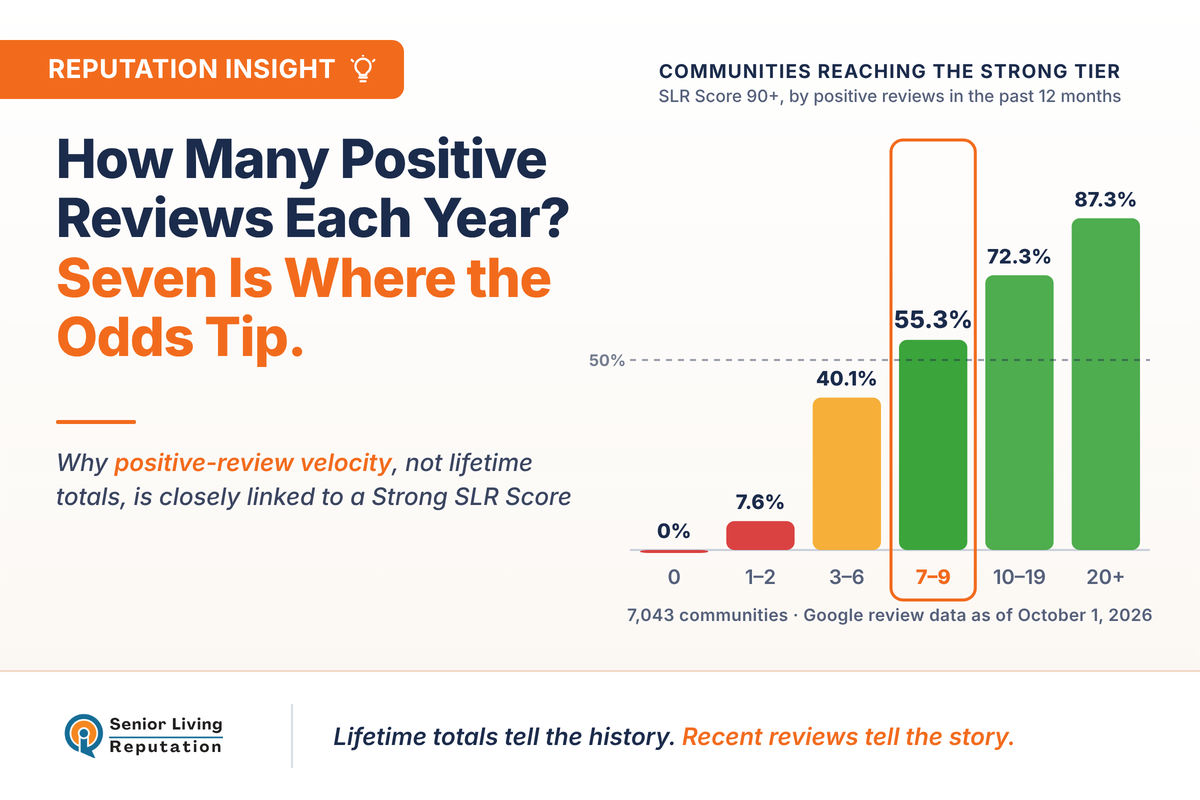
Our analysis of 7,043 communities shows how positive-review velocity relates to reaching the Strong SLR Score tier, and why seven positive reviews a year is a useful starting benchmark.
March’s leaderboard reveals a stable group of top-performing senior living brands, but growing divergence across the broader industry. The result is a widening gap between leaders and laggards.