When families visit a senior living community’s Google profile, the total review count shows how much feedback the community has accumulated over time.
But it does not answer another important question:
Are residents and families still sharing positive experiences today?
To explore that question, we analyzed the Google review performance of 7,043 senior living communities. Rather than focusing on lifetime review totals, we examined positive-review velocity: the number of positive reviews each community received during the previous 12 months.
The results show a strong relationship between the continuing flow of positive feedback and a community’s Senior Living Reputation Score (SLR Score).
The SLR Score is measured on a 100-point scale and considers overall Google rating, positive-review recency, positive reviews received during the past 12 months and sentiment across the three most recent reviews. Communities fall into three tiers: Strong (90 or higher), Needs improvement (75–89) and At risk (below 75).
The goal for every community should be the Strong tier. A Strong score indicates that a community is performing well across the signals families are most likely to notice: a solid overall rating, recent positive reviews, a steady flow of new feedback and positive sentiment in its latest reviews.
A large lifetime review count is valuable. It provides credibility, supports the overall rating and can make a profile more resilient when an occasional negative review appears.
But that history may not reflect what is happening at the community today.
Positive-review velocity provides a more current perspective. It shows whether residents and families are continuing to share positive experiences.
For this analysis, we grouped communities by the number of positive reviews they received during the previous 12 months. We then calculated what share of communities in each group reached the Strong tier.
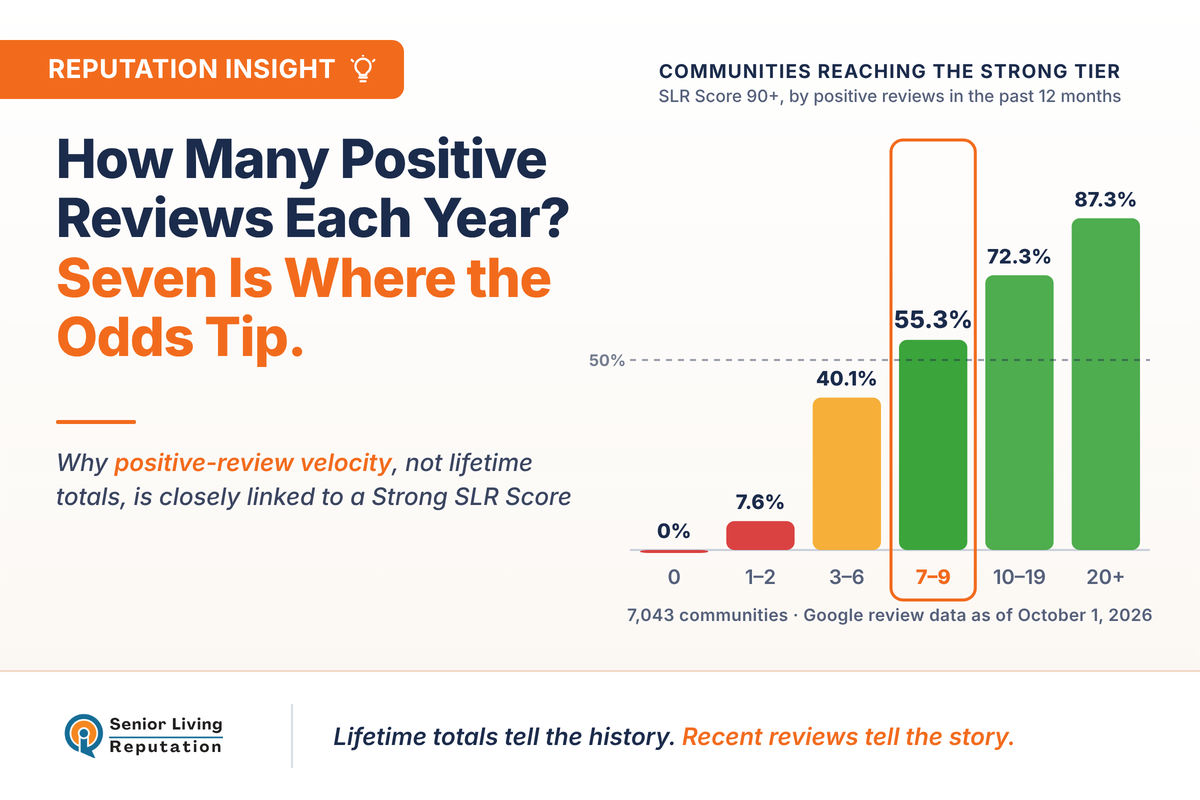
Among the 574 communities that received no positive reviews during the previous 12 months, none reached the Strong tier.
Communities receiving only one or two positive reviews performed somewhat better, but just 7.6% reached the Strong tier.
The likelihood of reaching Strong rose considerably as positive-review velocity increased:
These findings do not mean that receiving a particular number of reviews automatically produces a Strong score. Rating and recent sentiment still matter, and the experiences reflected in those reviews must be genuinely positive.
But the pattern is clear: communities with a steady flow of positive feedback are much more likely to reach the Strong tier.
Seven positive reviews during a rolling 12-month period is where the odds tip. It is the first group in which more than half of communities reached the Strong tier: 55.3% of those receiving seven to nine positive reviews, compared with 40.1% of those receiving three to six.
Results kept improving beyond that point. Nearly three-quarters of communities receiving 10 to 19 positive reviews reached the Strong tier. Among communities receiving at least 20, the figure approached nine out of 10.
Seven should therefore be viewed as a useful starting benchmark, not a quota or stopping point. Review generation works best as a consistent operating habit rather than a short-term campaign.
Positive-review velocity tells us how much positive feedback a community has generated. Recency tells us whether that feedback is still arriving.
Among communities that received a positive review within the past month, 64.6% were in the Strong tier. That share declined as the time since the latest positive review increased:
A community can therefore generate a reasonable number of positive reviews during the year and still lose momentum if they arrive in a short burst followed by months of inactivity.
Reaching the Strong tier is most closely associated with both sufficient volume and a dependable cadence.
The SLR Score is measured at the community level, but maintaining it requires alignment across the organization.
At the brand level, leaders should monitor positive-review velocity across every community, set realistic expectations and identify locations where activity has slowed. Portfolio averages alone can hide communities that have gone quiet.
At the community level, executive directors and local teams influence whether asking for authentic feedback becomes part of the normal operating rhythm. The objective is not to chase a one-time review target. It is to create consistent opportunities for residents and families to share their experiences.
Both levels should pay attention to the same early signals:
These signals help leadership act before a community’s overall rating, or its SLR Score tier, shows a more visible decline.
There is no single number of positive reviews that guarantees a strong online reputation.
The industry data does, however, provide useful benchmarks. Communities receiving fewer than three positive reviews during the previous year rarely reached the Strong tier. Seven is where more than half of communities reached Strong. At 10 or more, most communities reached the Strong tier.
The important distinction is that these are not lifetime review totals. They represent positive feedback received during a rolling 12-month period.
For operators, the goal is consistent participation across the portfolio. For community leaders, it is a sustainable flow of authentic feedback that keeps the local story current.
A strong reputation is not built only on what residents and families said in the past. It is reinforced by what they continue to say today.
This analysis includes 7,043 senior living communities and reflects Google review data captured on October 1, 2026. Communities with no Google reviews were excluded.
“Positive reviews during the past 12 months” refers to a rolling 12-month measure, not a calendar-year total or the lifetime number of reviews shown on a community’s Google profile. A positive review is a 4- or 5-star Google review.
The Senior Living Reputation Score (SLR Score) is a proprietary 100-point measure combining overall Google rating, positive-review recency, positive-review activity during the previous 12 months and sentiment across the three most recent reviews. Scores of 90 or higher fall in the Strong tier, 75–89 in Needs improvement and below 75 in At risk.
The findings show associations across the communities analyzed. Receiving a particular number of reviews does not, by itself, guarantee a specific score or business result.
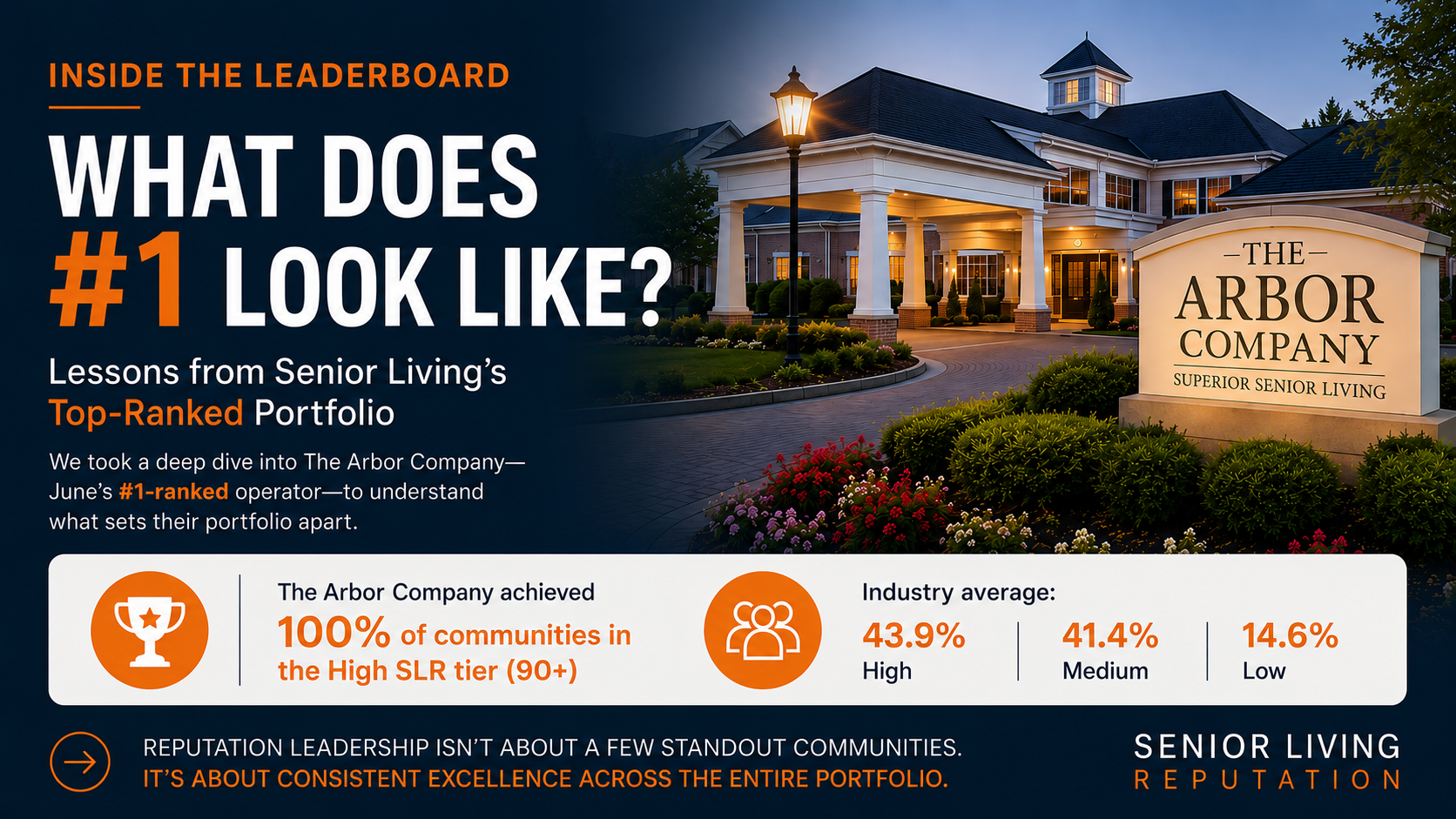
What does a top-ranked reputation portfolio actually look like? We examined The Arbor Company's June performance to understand what separates the industry's leaders.
Analysis of data across 6,600+ senior living communities reveals a widening gap in reputation performance. While many communities saw scores decline, others improved quickly through consistent review cadence and small, focused actions that made an outsized impact.